
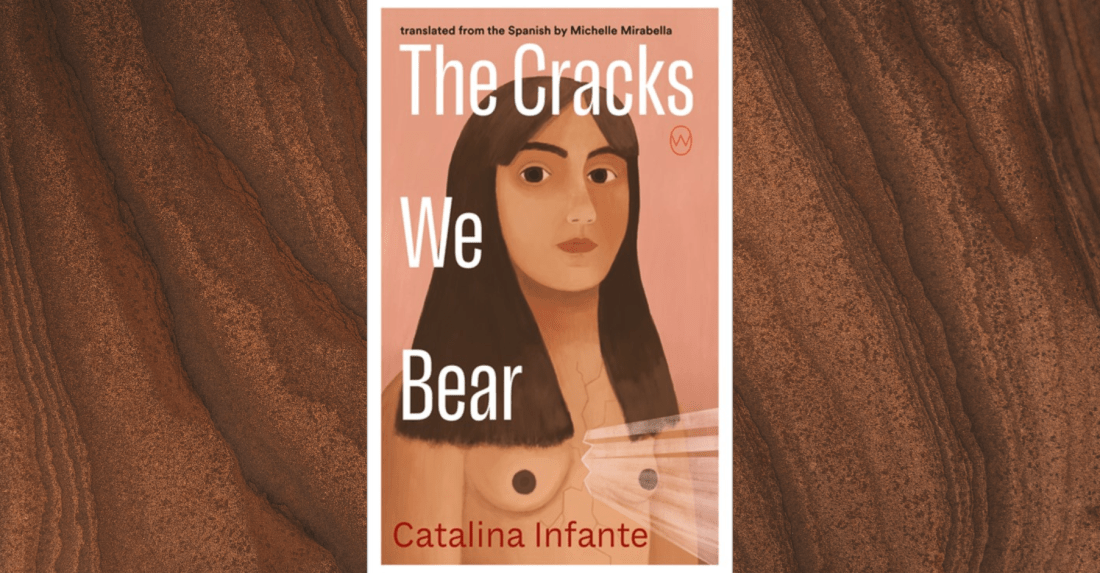
The Cracks We Bear marks Chilean writer Catalina Infante’s first book-length work to be translated into English (translated by Michelle Mirabella). And while slim, spanning just over 100 pages, it sings with a strong voice and incisive questions about mothering, both the act of being mothered and that of becoming one, and the interplay between these roles of mother and daughter.
The novel, set in Santiago, Chile, weaves back and forth between the present life of the protagonist Laura, who has moved back into her deceased mother’s home and is trying to get her bearings as a mother to an infant daughter, and the memories of Laura’s youth with her own mother, Esther, a member of the communist party who was exiled and later returned to Chile after the collapse of the Pinochet dictatorship. Scenes and reflections from throughout the timeline of Laura’s life unspool in short chapters one after another, forming a patchwork of sorts that slowly comes together to reveal a more cohesive portrait of a woman at a point of inflection and of reckoning.
As Laura comes into the role of motherhood, she realizes: “Our mothers are not what we believe them to be; our idea of them is just a character we’ve created for our own convenience, to survive, to keep ourselves going or to recount our own story.” But if a child can only truly see one version of the multitudinous versions their mother contains, how can they ever truly know this person so central to their very being, their sense of self? In the midst of her reckoning with her own mother’s death, as well as her absence as she enters motherhood herself, Laura also leafs through her identities beyond that seemingly all-consuming new label of mother, taking space from her husband, Felipe, as they renavigate their dynamic, and grasping back towards a sense of freeness, embodied in a new friendship with Daniela, a “pink-haired actress” who is ten years her youth.
As a new mother myself, just nine months into the journey, the novel stood out for its ability to articulate such specific yet relatable truths and observations about the experience, including those that when you are in it, can feel impossible to communicate, but upon sight on the page, inspire a gasp of recognition. Take, for instance, the “emergency trance” of the early days, and the unmooredness of postpartum, when Laura attempts to “recall what it is to be like that, to be that way in the world, with a body that’s light and free of burdens.” This incisiveness is surely helped in translation by Michelle Mirabella, who writes in her translator’s note that she first read the book “as a daughter, not yet a mother,” wrote first drafts “as [her] daughter grew inside [her],” and then “went back to revise” after birth, “armed with what [her] new motherhood continues to teach [her].”
Similarly, Laura seems to be unpeeling layer after layer throughout the book, as her present thrusts her into a rexamination of her past and its wounds, namely her unresolved grief over the loss of her mother, and raises questions of who she is now. Motherhood engenders a new understanding of her mother, now that she, too, occupies the role, but it also illuminates the cracks that existed in the relationship, which she must make peace with never being able to repair, or fully piece back together.
Now, rather than her and Esther, Laura realizes, “Antonia and I are that bond.” And as the book closes, it is Laura “embracing Antonia beneath the shadows of that maqui tree overlooking the ruins of an unknown house,” one in which a version of her mother she never knew once lived.
FICTION
The Cracks We Bear
By Catalina Infante
Translated by Michelle Mirabella
World Editions
Published October 21, 2025


